eval2_brg_g_eval1prompt
收藏资源简介:
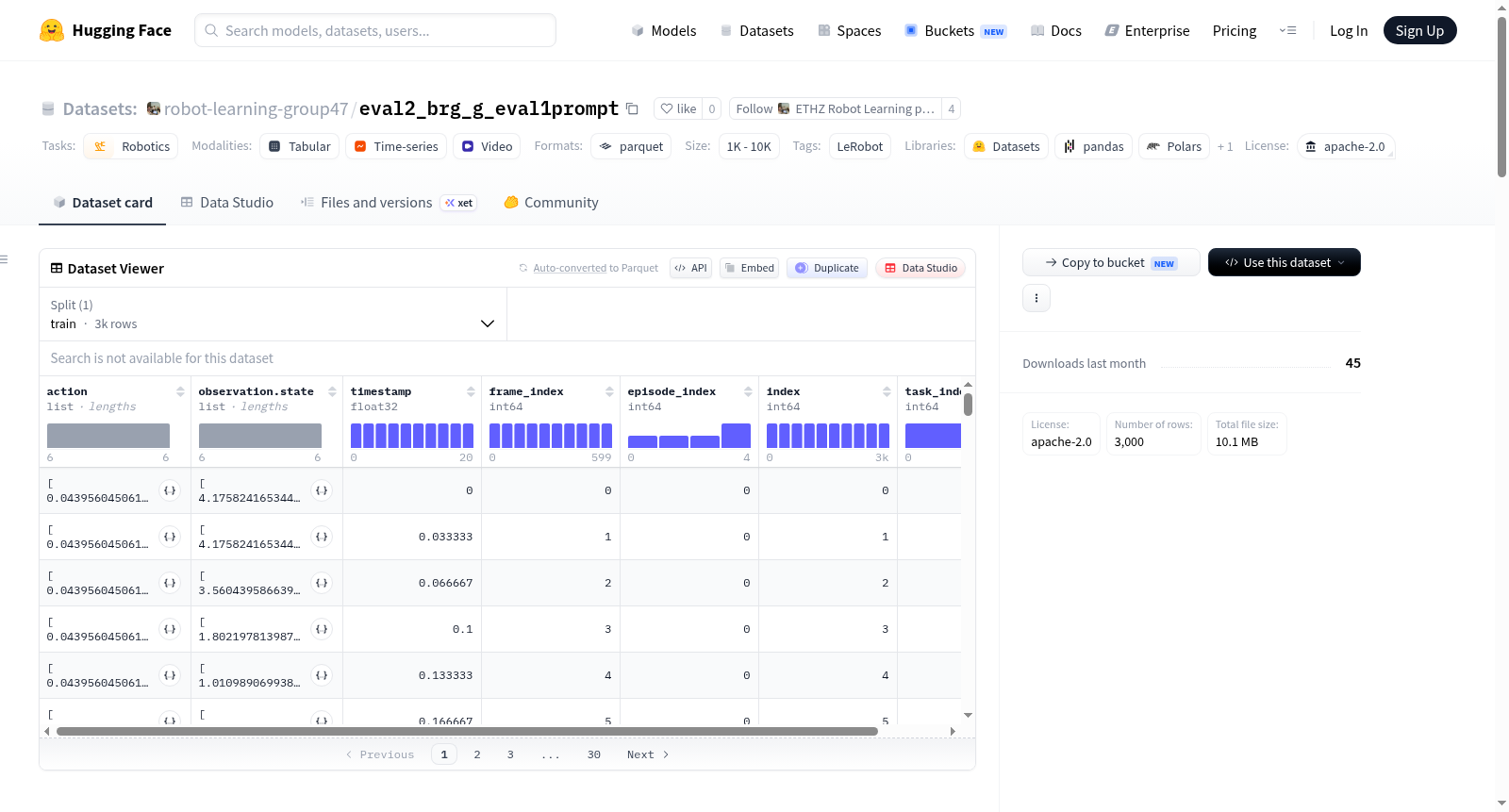
本数据集是使用LeRobot平台创建的机器人学习数据集,专为机器人学任务设计,包含机器人操作的多模态交互数据。数据规模包括5个完整的情节(episodes),总计3000个数据帧,涵盖1个具体任务。数据以30帧每秒的速率采集,并组织为训练集。数据集的核心内容包含以下特征字段:1) `action`:一个6维浮点向量,表示机器人末端执行器的关节位置指令,具体控制肩部平移、肩部抬升、肘部弯曲、腕部弯曲、腕部旋转和夹爪开合。2) `observation.state`:一个6维浮点向量,表示机器人本体的关节位置状态,其维度与`action`字段一一对应。3) `observation.images.front`:来自机器人前置摄像头的视觉观测,以视频形式存储,分辨率为640x480,包含RGB三个颜色通道,视频编码为AV1格式。4) 索引与计时字段:包括`timestamp`(时间戳)、`frame_index`(帧索引)、`episode_index`(情节索引)、`index`(全局索引)和`task_index`(任务索引),用于标识和定位数据。数据文件以Parquet格式存储,视频文件以MP4格式独立存储。该数据集适用于机器人模仿学习、强化学习、视觉伺服控制等任务的研究与模型训练。
This dataset is a robotic learning dataset created using the LeRobot platform, specifically designed for robotics research tasks, and contains multimodal interaction data for robot manipulation. The dataset includes 5 complete episodes, totaling 3000 data frames, covering 1 specific task. All data is collected at a rate of 30 frames per second (FPS) and organized as a training set. The core feature fields of the dataset are as follows: 1. `action`: A 6-dimensional floating-point vector representing joint position commands for the robot's end-effector, specifically controlling shoulder translation, shoulder elevation, elbow flexion, wrist flexion, wrist rotation, and gripper opening and closing. 2. `observation.state`: A 6-dimensional floating-point vector representing the joint position states of the robotic manipulator, with dimensions in one-to-one correspondence with the `action` field. 3. `observation.images.front`: Visual observations captured by the robot's front-facing camera, stored as video files with a resolution of 640×480, including three RGB color channels, and encoded in the AV1 format. Indexing and timing fields include `timestamp`, `frame_index`, `episode_index`, `index` (global index), and `task_index`, which are used to identify and locate data entries. Data files are stored in Parquet format, while video files are stored separately in MP4 format. This dataset is suitable for research and model training for tasks such as robot imitation learning, reinforcement learning, and visual servo control.