Data-Gouv-FR/indices-de-position-sociale-dans-les-lycees-a-partir-de-2022
收藏资源简介:
社会地位指数(IPS)用于通过学生父母的职业和社会类别(PCS)来评估学生的社会地位。每个PCS或PCS对都关联一个IPS数值,该数值是对与学业成功相关的一系列社会经济和文化属性的定量总结。IPS越高,学生平均社会背景越优越;IPS越低,学生社会背景越不利。IPS的计算基于统计方法,综合了描述学生生活条件的特征(参考Rocher, 2016年文章)。最初版本使用至2021年,基于2007年入读六年级的DEPP面板数据;2022年版本更新为基于2011年入读CP的DEPP面板数据。数据集提供了法国教育部管辖下的公立和私立高中(仅限高中阶段)的IPS平均值、学生IPS的标准差(反映社会异质性)以及学生人数。数据按学年组织,每行对应一个高中在特定学年的记录,并细分了普通与技术教育路径、职业教育路径以及整体高中阶段的学生。需要注意的是,IPS是一个简化指标,不能完全反映学生社会经济和文化复杂性;自2022年起,计算方法变更导致系列中断,且父母PCS未记录的学生被排除在计算之外。IPS平均值的差异在3分以内不建议过度解读。数据集还包括相关参考文献和进一步信息的链接。
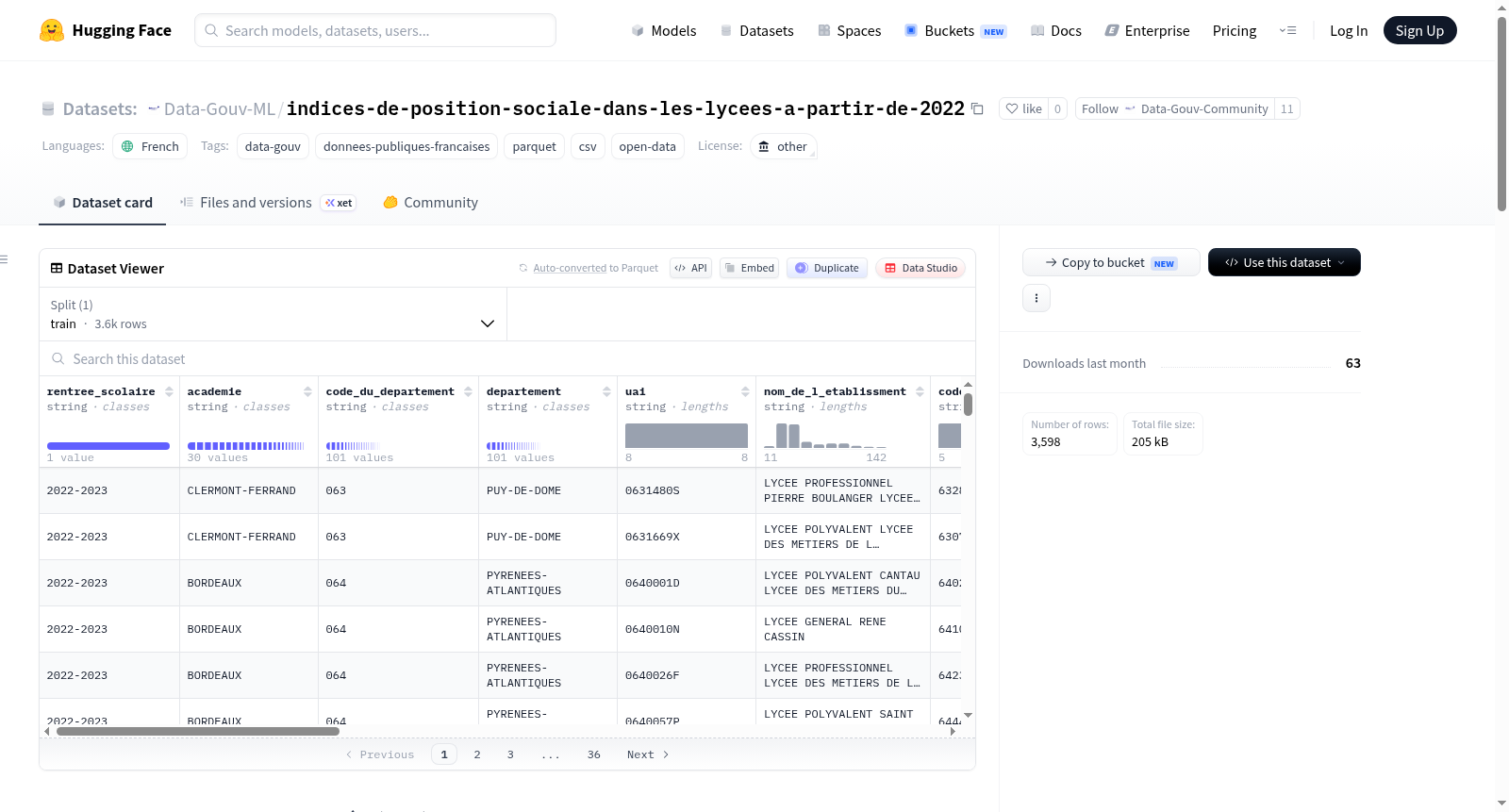
The Index of Social Position (IPS) is used to assess students' social status based on their parents' occupations and social categories (PCS). Each PCS or pair of PCS is associated with an IPS value, which is a quantitative summary of a set of socioeconomic and cultural attributes linked to academic success. Higher IPS values correspond to more advantaged average social backgrounds for students, while lower IPS values indicate more disadvantaged social backgrounds. The IPS is calculated using statistical methods that integrate characteristics describing students' living conditions (refer to Rocher, 2016). The initial iteration was utilized through 2021, based on DEPP panel data of students entering sixth grade in 2007; the 2022 version was updated to employ DEPP panel data of students entering CP in 2011. The dataset provides the average IPS value, the standard deviation of students' IPS (reflecting social heterogeneity), and the number of students for public and private high schools (upper secondary level only) under the jurisdiction of the French Ministry of Education. The data is organized by academic year, with each row corresponding to a record of a high school for a specific academic year, disaggregated by general and technological education tracks, vocational education tracks, and overall upper secondary student populations. Notably, the IPS is a simplified indicator and cannot fully capture the socioeconomic and cultural complexity of students' backgrounds; changes to the calculation methodology starting in 2022 resulted in a break in the time series, and students with unrecorded parental PCS were excluded from the calculations. Overinterpretation of differences in average IPS values of less than 3 points is not recommended. The dataset also includes relevant references and links to further information.